

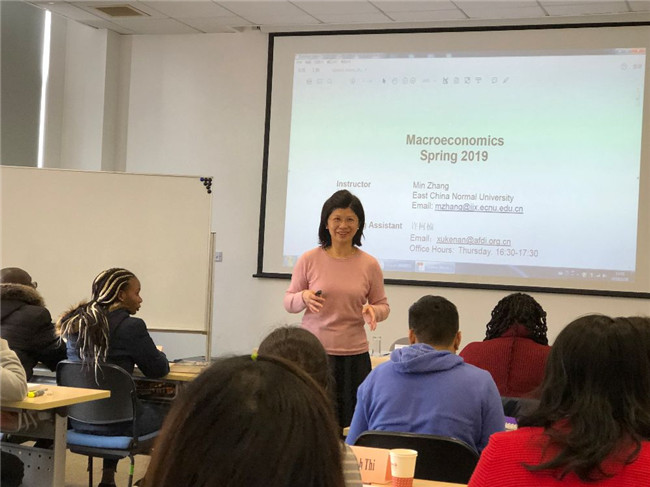
(撰文:Huot Borin;摄影:陈宝莲)3-4月,2018级留学生参加了由张敏教授主讲的《宏观经济学》课程,反响良好,获益匪浅。来自柬埔寨的留学生Huot Borin专门撰文对课程内容进行总结回顾,并对宏观经济学原理在日常生活中的应用进行了深度思考分析。
This is second semester for me studying in SNAI, in the second semester’s curriculum, there are 8 courses, one among them is Macroeconomics. This course contains 18 chapters which was designed for two credits with eight lectures, but due to time constraint, our instructor cited the most important part which cover 10 chapters. Those chapter are Introduction of Macroeconomic, Measurement, Consumer and Firm Behavior, a Closed-Economy One-Period Macroeconomic Model, Economic Growth, Two-Period Model, a Real Intertemporal Model with Investment, a Monetary Intertemporal Model, Market-Clearing Models of the Business Cycle, and Money, and Inflation and Monetary Policy. The course has enlightened students about aggregated indicators such as GDP, unemployment rates, national income, price indices, and the interrelations among the different sectors of the economy to better understand how the whole economy functions.
We live in a complex and interconnected world. No one is unaffected by the economy. The study of macroeconomics allows us to have better understand what makes our economy grow and what makes it contract. A growing economy provides opportunities for better lives, while a contracting economy can be disastrous for most everyone. By using macroeconomic model, it enables us to interpret the economic phenomena and forecast economic conditions to help consumers, firms, and governments make better decisions. Consumers want to know how easy it will be to find work, how much it will cost to buy goods and services in the market, or how much it may cost to borrow money. Businesses use macroeconomic analysis to determine whether expanding production will be welcomed by the market. From macroeconomic indicator, government make appropriate decision and policy on budgeting spending, taxation, interest rates, and money supply to ensure substantial economic growth.
During the lectures, I am really interested in one chapter which talk about Consumer and Firm Behavior. This chapter point out how a consumer makes choices concerning the trade-off between consuming and working in a range of their budget constraint and firm’s decision concerning on how many labors should be hired and products should be produced. The chapter figured out what factors could change the consumer and firm behavior and what is the effect of changing preference of consumer and firm on economy as well. After learning this chapter, it enables me to understand what happen to consumer’s behavior if price of goods increase? What will firm react if increase in demand for consuming? How consumer and firm change their behavior after government increase in tax? The reasons I like this chapter is because I can apply those theories to my own case, for example, if the price of my favorite fast food Mc Donald burger is increased, I maybe eat Mc Donald burger less frequently, or I maybe change my preference to eat other substitute product like Burger King. The change in price could change my consumption behavior and preference respond to the change in consuming price. By imagining and applying my own case, I can understand whether the theory of consumer and firm behavior in the textbook is rational.
It's really important to understand how our economy functions overall. We can participate in something effectively when we understand how it functions. For example, if you hear that maybe interest rates are going to rise in the near future, if you don't know how that might impact you yourself, you're not effectively participating in our society. So how might that impact your spending and your saving habits now, or in the future, when they do rise? That's just one example of how understanding these things is very important to you personally, and as a participant in our economy.
This course enables me to understand the basic understanding of macroeconomic concepts interpreting economic phenomena, key factors to boost sustain economic growth and use macroeconomic model to explain the relationship between income, output, consumption, unemployment, inflation, saving, and investment. As I am a central banker, it is vital for me to understand the role of central bank in implement monetary policy, especially money supply and impact of making inappropriate policy decision.




 财政部微信
财政部微信
 上海国家会计学院微信


